
Passivated Tubing
Stainless steel tubing chemically treated to remove free iron particles from the surface and enhance the natural chromium oxide layer, significantly improving corrosion resistance.
Removing the iron that machining leaves behind
Machining, grinding and cutting introduce free iron particles into a stainless surface, and those particles are what rust first. Passivation removes them and reinforces the chromium oxide film so the passive layer completely separates the metal from the corrosive medium.
The treatment does not change tube thickness — dimensional accuracy is preserved and in practice improved. The resulting film is more corrosion resistant than anti-rust oil methods and remains stable in service.
Citric acid passivation is environmentally friendly and the agent is reusable with a long service life, which makes the process cost-effective at production volumes.
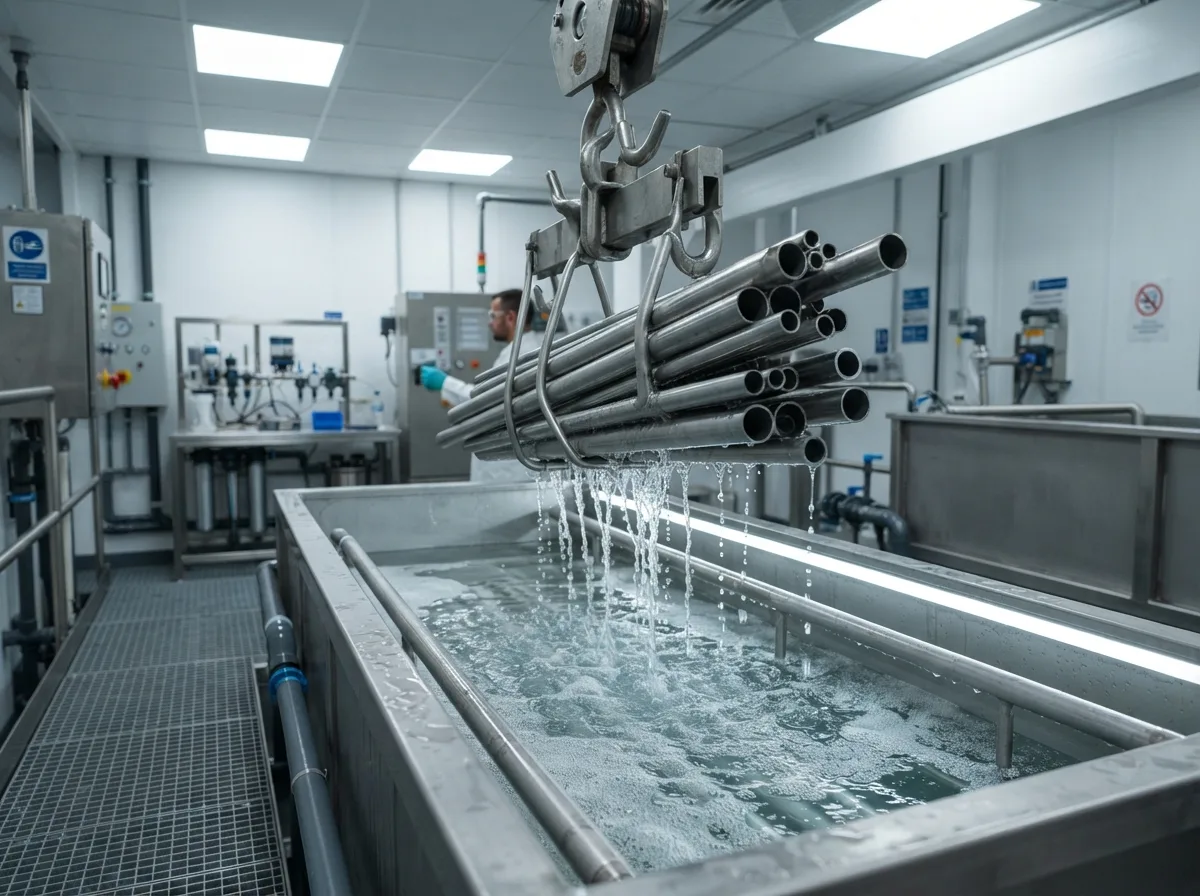
What passivation delivers
Free iron removal
Eliminates the embedded particles from machining, grinding and cutting that cause rust.
Enhanced resistance
The passive film completely separates the metal from the corrosive medium.
No dimensional change
Tube thickness is unchanged and dimensional accuracy is improved.
Stable and economical
More corrosion resistant than anti-rust oil, with a reusable, long-life agent.
| Step | Action |
|---|---|
| 1. Pre-cleaning | Remove surface dirt, grease and oil mechanically |
| 2. Degreasing | Lyes, emulsifiers, organic solvents or steam |
| 3. Acid treatment | Immerse in nitric or citric acid solution |
| 4. Rinsing | Thorough water rinse to remove acid residues |
| 5. Drying | Complete drying to prevent water spots |
| 6. Protection | Cover with polyethylene film to avoid dissimilar metal contact |
Where passivated tubing is used
What to send us for a firm quote
The more of this we have up front, the faster the quotation and the fewer clarifications later. Partial enquiries are welcome — we will tell you what else the specification needs.
Send an enquiryPassivated Tubing — common questions
Why does stainless steel need passivation?
Machining, grinding and cutting introduce free iron particles that rust first. Passivation removes them and reinforces the chromium oxide film so the passive layer separates the metal from the corrosive medium.
Does passivation change tube dimensions?
No. Wall thickness is unchanged and dimensional accuracy is in practice improved.
Nitric or citric acid?
Both are used. Citric acid is environmentally friendly, and the agent is reusable with a long service life, which makes it cost-effective at volume.
How is the tube protected afterwards?
After thorough rinsing and complete drying, tubes are covered with polyethylene film to avoid dissimilar metal contact and water spotting.
Enquire about Passivated Tubing
Send grade, OD, wall, length, standard and finish for a firm quotation.