
Instrumentation Tubing
Small-diameter, high-precision tube for pressure, vacuum and signal lines in process and instrumentation systems, held to very tight OD and wall tolerances for leak-free compression fittings.
Tolerances tight enough for a compression fitting
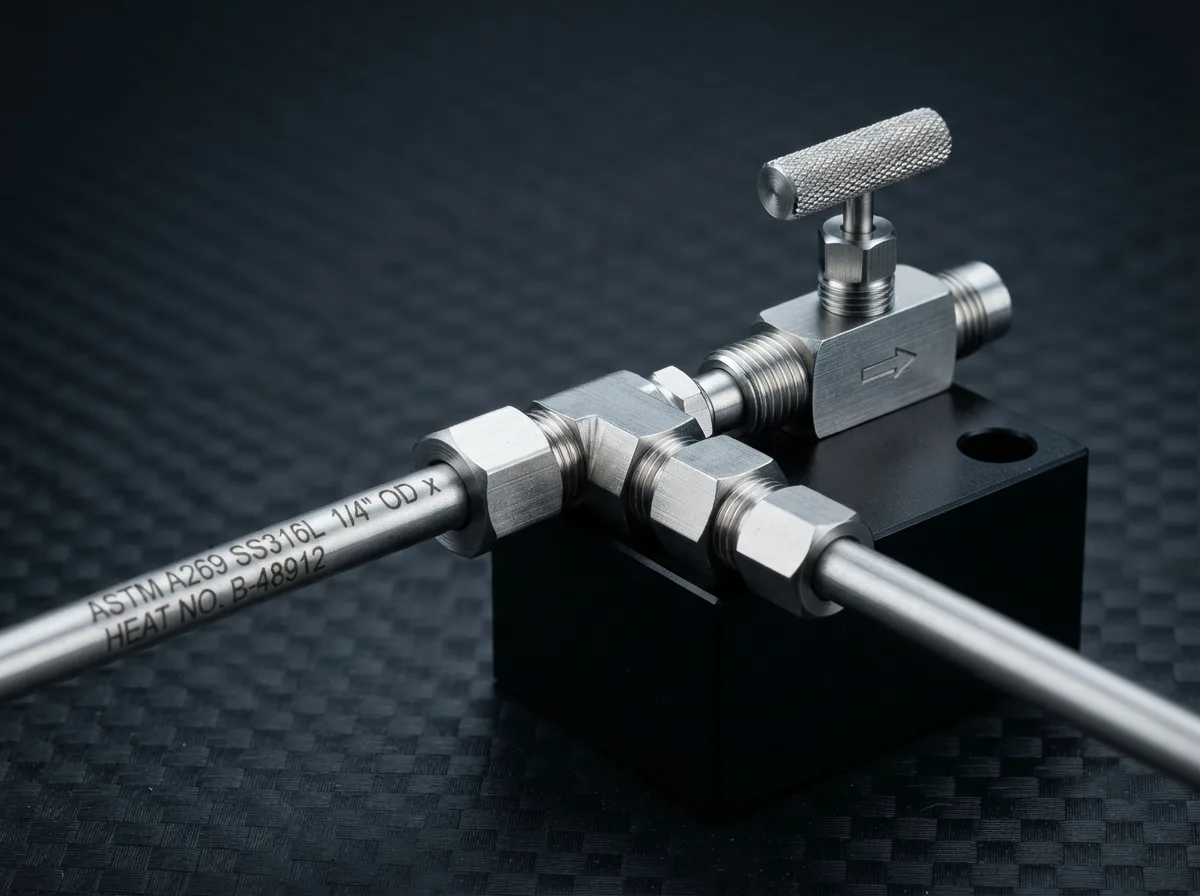
Instrumentation tubing is almost always seamless and cold drawn, supplied in straight lengths or coils. Very tight tolerances on OD and wall thickness are what allow a compression fitting to seal reliably on transmitters, analysers and safety circuits.
Tubes are usually supplied in bright annealed or polished finish for a smooth internal bore and easy cleaning. 304 and 304L serve mild environments; 316 and 316L are the most common choice for process plants because of their resistance to chlorides, acids and coastal service.
Each and every tube is pressure tested and inspected by eddy current or ultrasonic methods for discontinuities.
What precision tubing must deliver
Leak-free joints
Tight OD and wall control is what makes compression fittings seal first time, every time.
Smooth bore
Bright annealed or polished finishes reduce roughness and particle retention.
Cold drawn accuracy
Drawing through dies and mandrels holds dimensional tolerance along the full length.
Verified integrity
Pressure testing plus eddy current or ultrasonic inspection on every lot.
| OD (metric) | OD (inch) | Typical wall range | Typical use case |
|---|---|---|---|
| 6 – 8 mm | 1/4 in | 0.6 – 1.5 mm | Small signal lines, pneumatic |
| 10 – 12 mm | 3/8 – 1/2 in | 1.0 – 2.0 mm | General process instrument lines |
| 15 – 20 mm | 1/2 – 3/4 in | 1.5 – 2.5 mm | Higher-pressure instrument and small process |
| 25 mm | 1 in | 2.0 – 3.0 mm | Main header or small process lines |
Where instrumentation tubing is used
What to send us for a firm quote
The more of this we have up front, the faster the quotation and the fewer clarifications later. Partial enquiries are welcome — we will tell you what else the specification needs.
Send an enquiryInstrumentation Tubing — common questions
Why do tolerances matter so much on instrument tube?
Compression fittings seal on the tube surface. Tight OD and wall control is what allows the ferrule to grip and seal reliably first time.
Which grade should I specify?
304 and 304L suit mild environments. 316 and 316L are the most common choice for process plants because of better resistance to chlorides, acids and coastal service.
Is the tube supplied in coils or straight lengths?
Both. Straight lengths and coils are available, cold drawn seamless and annealed with a bright annealed or polished bore.
What testing is carried out?
Hydrostatic or pneumatic pressure testing, plus eddy current or ultrasonic inspection for discontinuities, with EN 10204 3.1-3.2 certification.
Enquire about Instrumentation Tubing
Send grade, OD, wall, length, standard and finish for a firm quotation.